Frontend development has become significantly more complex over the last few years. Modern applications are expected to load instantly, remain accessible, scale across teams, and support continuous deployment. While frameworks and tooling have improved, one challenge remains constant: maintaining high frontend code quality.
Many development teams discover quality issues only after bugs reach production. Components become difficult to maintain, technical debt grows, and onboarding new developers becomes slower. The result is a codebase that works today but becomes increasingly expensive to evolve tomorrow.
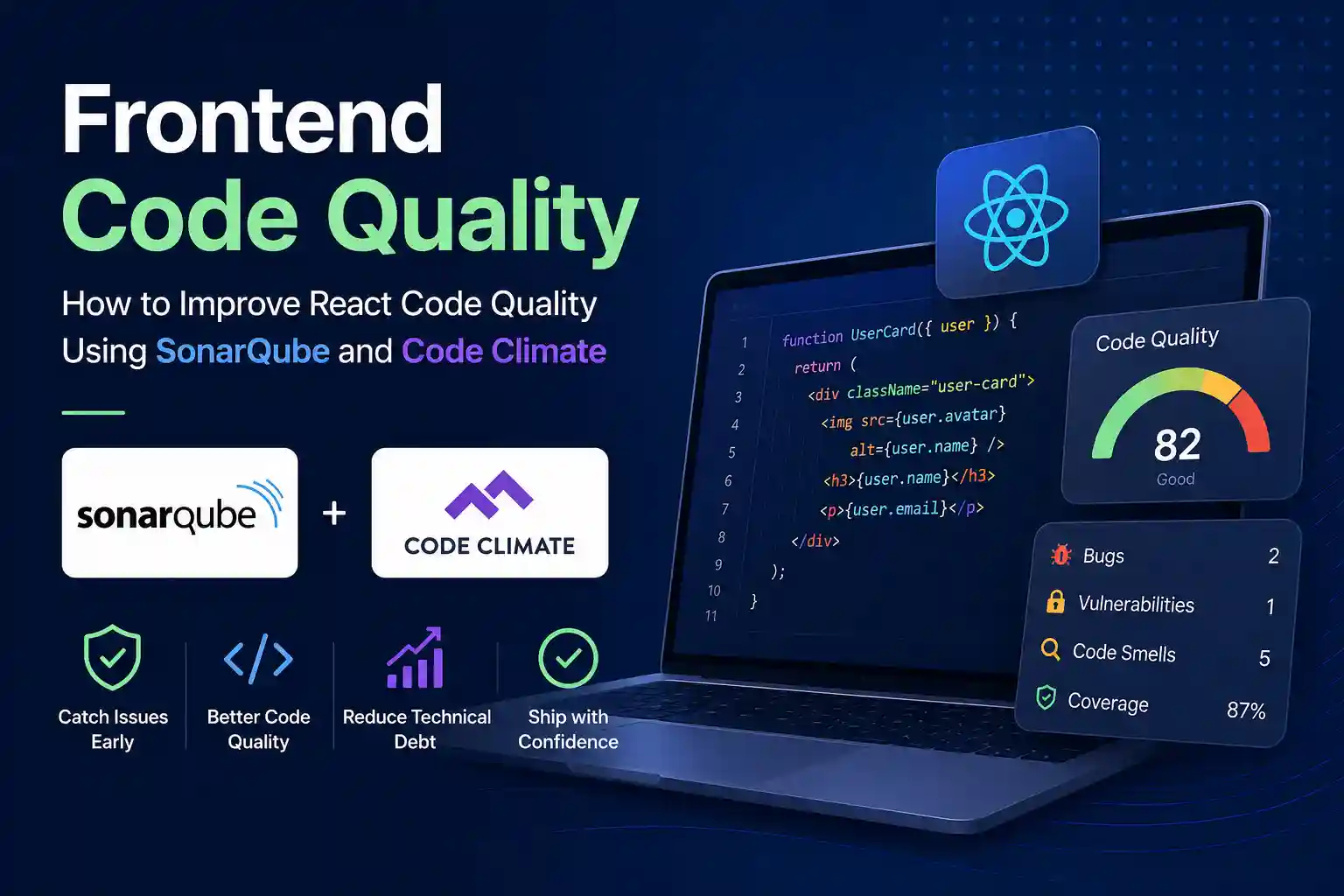
The good news is that frontend code quality is measurable and can be improved. Modern tools such as SonarQube and Code Climate help engineering teams identify issues early, enforce coding standards, and maintain healthier codebases at scale.
In this guide, you’ll learn what frontend code quality really means, why it matters for business outcomes, how SonarQube and Code Climate work, and practical techniques used by high-performing engineering teams worldwide.
What Is Frontend Code Quality?
Frontend code quality refers to how easy your code is to understand, maintain, test, extend, and debug over time. High-quality frontend code does more than work. It remains reliable as new features are added and team members change.
A quality frontend codebase typically demonstrates:
- Readable and consistent code structure
- Low complexity and duplication
- Strong test coverage
- Accessibility compliance
- Performance-conscious implementation
- Maintainable component architecture
- Secure coding practices
For example, a React component containing 500 lines of business logic may technically function correctly. However, it becomes difficult to test, maintain, and modify. Splitting that component into smaller reusable pieces significantly improves long-term quality.
Why Frontend Code Quality Matters
Poor code quality creates hidden costs that often exceed the initial development effort.
- Slower feature delivery
- More production bugs
- Higher maintenance costs
- Longer onboarding periods
- Reduced developer productivity
- Increased technical debt
According to research published by the Sonar technical debt guide, organizations often spend a substantial portion of development time fixing existing code issues rather than building new functionality.
This is why leading engineering organizations treat code quality as an ongoing process rather than a one-time cleanup activity.
Common Frontend Code Quality Problems
Before improving quality, it helps to understand the most frequent issues found in modern frontend applications.
Large Components and Files
One of the most common React problems is oversized components that handle rendering, state management, API calls, validation, and business logic simultaneously.
These components quickly become difficult to understand and nearly impossible to test effectively.
Code Duplication
Developers often copy existing functionality to accelerate delivery. While this may save time initially, duplicated logic creates maintenance challenges later.
A bug fixed in one location may remain unresolved elsewhere.
Inconsistent Coding Standards
Without shared conventions, teams produce different approaches to solving similar problems.
This inconsistency increases cognitive load during reviews and slows collaboration.
Weak Test Coverage
Applications lacking sufficient automated tests become risky to modify. Developers may avoid refactoring because they cannot confidently verify behavior.
Performance Issues
Frontend quality also includes performance. Excessive rendering, large bundles, and inefficient state updates negatively affect user experience.
Teams working on performance optimization may benefit from reading related content about Frontend Performance Profiling: Complete Chrome DevTools Guide to Debug and Optimize Modern Web Apps to identify bottlenecks before they become production issues.
How SonarQube Improves Frontend Code Quality
SonarQube has become one of the most widely adopted code quality platforms in software engineering. It performs static code analysis and helps teams identify maintainability, reliability, and security issues before deployment.
What SonarQube Analyzes
For frontend applications, SonarQube can analyze:
- JavaScript
- TypeScript
- React applications
- Vue projects
- Angular applications
- CSS and styling issues
The platform evaluates:
- Code smells
- Bugs
- Security vulnerabilities
- Duplicated code
- Complexity metrics
- Coverage reports
Example: Detecting Complex React Logic
Imagine a React component containing multiple nested conditional statements, API calls, and extensive state manipulation.
SonarQube can flag the component’s cognitive complexity score and recommend simplification. This helps teams maintain readability before complexity becomes unmanageable.
Quality Gates
One of SonarQube’s most valuable capabilities is Quality Gates.
Quality Gates allow teams to define minimum quality standards before code reaches production.
Examples include:
- No critical security vulnerabilities
- Minimum 80% test coverage
- No new duplicated code
- Limited maintainability issues
If a pull request fails these requirements, deployment can be blocked automatically.
CI/CD Integration
Modern engineering teams typically integrate SonarQube directly into CI/CD pipelines.
This aligns naturally with deployment automation practices discussed in GitLab Frontend Deployment Automation: How Scalable Teams Ship Faster with CI/CD.
Quality analysis becomes part of every deployment rather than an occasional manual review.
How Code Climate Helps Maintain Healthy Frontend Projects
While SonarQube focuses heavily on static analysis, Code Climate provides additional visibility into maintainability trends and engineering performance.
Many teams use both platforms together because they address different aspects of code quality.
Key Features of Code Climate
- Maintainability scoring
- Technical debt tracking
- Pull request analysis
- Code duplication detection
- Test coverage reporting
- Engineering insights
Code Climate’s maintainability score gives teams a simple way to monitor whether code quality is improving or declining over time.
Monitoring Technical Debt Growth
Technical debt rarely appears overnight.
Instead, it accumulates gradually through shortcuts, rushed releases, and inconsistent architectural decisions.
Code Climate helps visualize these trends before they become serious engineering problems.
For example, if duplicate React hooks begin spreading across multiple features, maintainability metrics often reveal the trend long before developers notice it manually.
Pull Request Feedback
One of the strongest use cases for Code Climate is automated pull request analysis.
Developers receive immediate feedback about complexity, duplication, and maintainability issues during code review.
This creates a quality-first culture where problems are addressed early instead of accumulating over time.
Practical Steps to Improve Frontend Code Quality
Tools alone do not improve quality. Teams must combine tooling with effective engineering practices.
Establish Clear Coding Standards
Start with documented conventions covering:
- File structure
- Naming patterns
- Component organization
- State management practices
- Testing requirements
Consistency reduces friction across large teams.
Use TypeScript Wherever Possible
TypeScript catches many errors before runtime.
Strong typing improves maintainability, editor tooling, and developer confidence when refactoring large applications.
Keep Components Small
A useful rule followed by many experienced frontend engineers is that each component should have one primary responsibility.
Smaller components are easier to test, understand, and reuse.
Automate Linting
ESLint should run automatically during development and CI workflows.
Automated enforcement removes subjective debates from code reviews.
Implement Consistent Code Reviews
Even with automated tooling, human reviews remain essential.
A strong code review process should focus on:
- Readability
- Maintainability
- Business logic correctness
- Accessibility
- Performance implications
Reviewers should avoid focusing exclusively on formatting issues because those can be automated through ESLint and Prettier.
Invest in Automated Testing
Frontend testing is one of the strongest indicators of long-term code quality.
A balanced testing strategy typically includes:
- Unit tests
- Integration tests
- End-to-end tests
Teams using React commonly combine Jest, React Testing Library, and Playwright to achieve broad coverage.
React Code Quality Best Practices for Modern Applications
React remains one of the most popular frontend frameworks globally. However, its flexibility can create maintainability challenges when teams lack clear architectural guidelines.
Avoid Business Logic Inside JSX
Complex business logic embedded directly within JSX reduces readability.
Instead, extract logic into helper functions, hooks, or service layers.
Poor example:
return (
  <div>
    {users.filter(user => user.active)
      .sort((a,b) => a.name.localeCompare(b.name))
      .map(user => (
        <UserCard key={user.id} user={user}/>
      ))}
  </div>
)
Better approach:
const activeUsers = getSortedActiveUsers(users);

return (
  <div>
    {activeUsers.map(user => (
      <UserCard key={user.id} user={user}/>
    ))}
  </div>
);
The second example improves readability and simplifies testing.
Create Reusable Custom Hooks
Custom hooks help centralize logic and reduce duplication.
Instead of repeating API-fetching logic across multiple components, create reusable hooks that encapsulate data retrieval and state management.
Adopt Feature-Based Folder Structures
As applications grow, organizing files by feature rather than file type often improves maintainability.
For example:
features/
 ├─ authentication/
 ├─ dashboard/
 ├─ billing/
 └─ settings/
This structure scales more effectively than large folders dedicated solely to components, hooks, or services.
Use Performance Monitoring Alongside Code Quality Metrics
Clean code does not automatically guarantee fast applications.
Teams should combine code quality analysis with performance profiling.
A useful related resource is Frontend Performance Profiling: Complete Chrome DevTools Guide to Debug and Optimize Modern Web Apps, which explores identifying rendering bottlenecks and performance regressions in production-grade applications.
Building a Frontend Code Quality Workflow with SonarQube and Code Climate
The most successful engineering organizations treat quality as part of the development lifecycle rather than a separate activity.
A practical workflow may look like this:
- Developer writes code
- ESLint and TypeScript validate locally
- Pull request is opened
- Code Climate analyzes maintainability
- SonarQube performs static analysis
- Automated tests execute
- Quality Gates validate standards
- Code review occurs
- Deployment proceeds through CI/CD pipeline
This layered approach significantly reduces the likelihood of quality issues reaching production environments.
Example CI/CD Quality Pipeline
Many organizations using GitLab, GitHub Actions, or Azure DevOps implement quality checks before deployment approval.
A typical pipeline includes:
- Linting
- Unit testing
- Coverage validation
- SonarQube scanning
- Code Climate analysis
- Build verification
- Deployment approval
This approach aligns closely with modern deployment strategies covered in GitLab Frontend Deployment Automation: How Scalable Teams Ship Faster with CI/CD.
The Relationship Between Frontend Architecture and Code Quality
Architecture decisions have a direct impact on long-term maintainability.
Even the best code quality tools cannot fully compensate for poor architectural choices.
Monolith Frontends
Monolithic frontend applications are often simpler initially, but can become difficult to scale as teams grow.
Large codebases frequently experience:
- Slower builds
- Complex dependencies
- Difficult deployments
- Higher merge conflict frequency
Micro Frontends
Micro frontend architectures can improve maintainability when implemented thoughtfully.
Independent teams gain ownership over specific domains while reducing coupling across the organization.
Readers evaluating architectural trade-offs may find value in Monolith Frontend vs Micro Frontend Architecture.
Monorepos and Code Quality
Organizations managing multiple frontend applications often adopt monorepos.
Tools such as Nx make it easier to share libraries, standardize tooling, and enforce quality policies consistently.
For teams exploring this approach, a natural follow-up resource is Step-by-Step React Monorepo Setup with Nx: Complete Guide for Scalable Project .
Advanced Frontend Code Quality Metrics Worth Tracking
High-performing engineering teams monitor more than bug counts.
Useful frontend quality metrics include:
- Cyclomatic complexity
- Cognitive complexity
- Code duplication percentage
- Technical debt ratio
- Test coverage
- Accessibility violations
- Bundle size growth
- Performance scores
- Security vulnerabilities
Both SonarQube and Code Climate provide visibility into many of these measurements.
The goal is not to achieve perfect scores. The goal is to identify negative trends early enough to correct them.
Code Quality and Frontend Performance Go Hand in Hand
Well-structured code often leads to better performance outcomes.
For example:
- Smaller reusable components reduce unnecessary rendering
- Clear state management reduces update complexity
- Code splitting improves loading speed
- Reusable hooks simplify optimization
Developers implementing lazy-loading strategies can explore Smart React Lazy Rendering in 2026: Build Smarter Components with Intersection Observer for Better Performance for practical optimization techniques.
Likewise, understanding browser rendering pipelines becomes easier through GPU Acceleration in Browsers Explained: How Modern Rendering Delivers Faster Web Performance.
Frequently Asked Questions
What is frontend code quality?
Frontend code quality refers to how maintainable, readable, secure, testable, and scalable frontend code remains over time. High-quality code reduces bugs, simplifies collaboration, and supports faster feature development.
Is SonarQube good for React applications?
Yes. SonarQube supports JavaScript and TypeScript analysis and can identify code smells, complexity issues, duplicated code, security vulnerabilities, and testing gaps within React applications.
What is the difference between SonarQube and Code Climate?
SonarQube focuses heavily on static code analysis, security, reliability, and maintainability. Code Climate emphasizes maintainability scoring, engineering insights, technical debt tracking, and pull request quality monitoring.
How can I improve React code quality quickly?
Start by introducing TypeScript, ESLint, automated testing, smaller components, reusable hooks, code reviews, and continuous quality analysis through tools such as SonarQube and Code Climate.
Do code quality tools improve application performance?
Indirectly, yes. While quality tools primarily focus on maintainability and reliability, cleaner architecture and reduced complexity often contribute to improved frontend performance and scalability.
So,
Frontend code quality is not a one-time initiative. It is an ongoing engineering discipline that influences maintainability, performance, security, developer productivity, and business outcomes.
Tools such as SonarQube and Code Climate provide valuable visibility into code health, but sustainable quality comes from combining automation with strong development practices, thoughtful architecture, code reviews, testing, and continuous improvement.
Whether you manage a small React application or a large enterprise frontend platform, investing in code quality today will reduce technical debt, accelerate future development, and create a more reliable experience for both developers and users.
As your next step, consider auditing your current frontend codebase, introducing automated quality gates, and exploring related topics such as frontend architecture, performance profiling, deployment automation, and scalable monorepo development.