Modern frontend applications are no longer simple websites with a few pages and forms. Teams today build complex dashboards, enterprise SaaS platforms, eCommerce ecosystems, fintech applications, streaming platforms, and real-time collaboration tools that evolve continuously.
As frontend systems grow, one architectural question appears almost everywhere:
Should you keep a monolithic frontend or move to a micro frontend architecture?
This decision directly affects:
- Team productivity
- Deployment speed
- Code maintainability
- Scalability
- Developer experience
- Release cycles
- Long-term technical debt
Many engineering teams adopt micro frontends too early because they sound modern. Others stay with monoliths for too long and struggle with slow releases, merge conflicts, and bloated codebases.
The reality is more nuanced.
A monolith frontend can still be the best choice for many products. At the same time, micro frontends solve real scaling problems for large organisations with multiple teams.
In this guide, you will learn:
- What monolith frontend architecture means
- What micro frontends are
- The core differences between both approaches
- Advantages and disadvantages of each
- Real-world use cases
- Performance and deployment considerations
- How large engineering teams choose between them
- Common mistakes teams make in 2026
If you are planning frontend architecture for a growing product, this comparison will help you make a practical and future-proof decision.
What Is a Monolith Frontend Architecture?
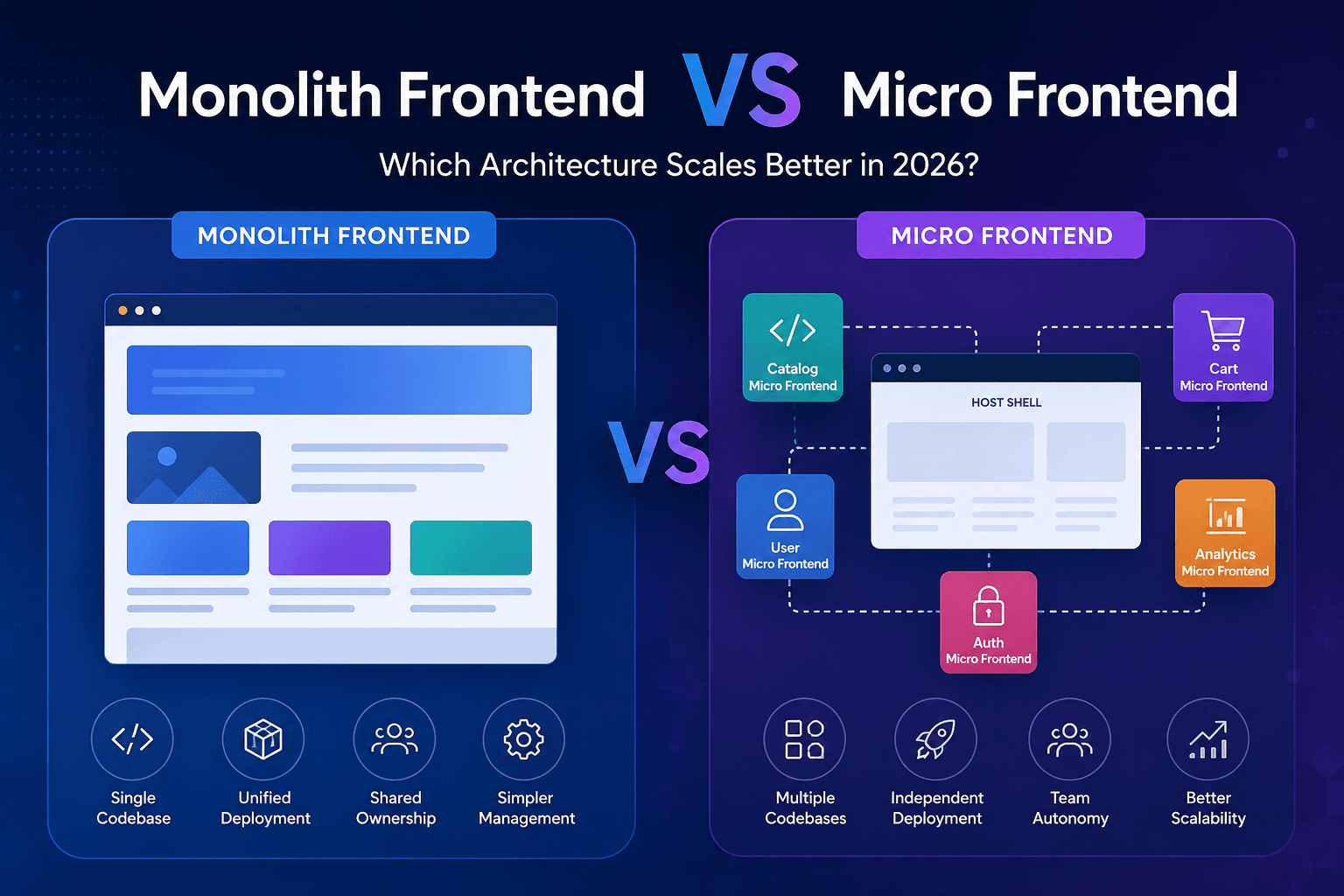
A monolith frontend is a single, unified frontend application where all features, modules, UI components, routing, and business logic live inside one codebase and are deployed together.
Most traditional React, Angular, or Vue applications start as monolith frontends.
Common Characteristics of Monolithic Frontends
- Single repository or tightly coupled repository structure
- Shared build pipeline
- One deployment process
- Centralised state management
- Shared dependencies
- One frontend release artifact
Simple Example
An eCommerce application may contain:
- Product listing
- Cart
- Checkout
- User profile
- Admin dashboard
In a monolith frontend, all these modules exist inside one application bundle.
Even if separate teams work on different features, deployment still happens together.
What Is Micro Frontend Architecture?
Micro frontend architecture extends the idea of microservices into the frontend layer.
Instead of one large frontend application, the UI is divided into smaller independently developed and deployed frontend modules.
Each micro frontend usually owns:
- Its own codebase
- Build process
- Deployment pipeline
- UI logic
- Team ownership
These frontend modules are combined at runtime or build time to create a complete application experience.
Real-World Example
A large SaaS platform may split frontend ownership like this:
| Team | Micro Frontend Ownership |
|---|---|
| Payments Team | Billing UI |
| Analytics Team | Dashboard UI |
| Authentication Team | Login and security |
| Marketplace Team | Product management |
| Support Team | Ticketing interface |
Each team can release changes independently without waiting for a central frontend deployment.
Monolith Frontend vs Micro Frontend: Core Differences
| Feature | Monolith Frontend | Micro Frontend |
|---|---|---|
| Codebase | Single | Multiple |
| Deployment | Unified deployment | Independent deployments |
| Team Ownership | Shared | Autonomous |
| Scalability | Moderate | High |
| Complexity | Lower initially | Higher initially |
| Release Speed | Slower at scale | Faster for large teams |
| Dependency Management | Centralised | Distributed |
| Testing | Easier initially | More complex |
| Performance | Usually simpler | Requires optimisation |
| Best For | Small to medium apps | Large enterprise platforms |
Advantages of Monolithic Frontends
Despite all the hype around distributed systems, monolith frontends still work extremely well for many businesses.
1. Easier Development Setup
A monolithic frontend is easier to start and manage.
New developers can:
- Clone one repository
- Install dependencies
- Run one application
This simplicity reduces onboarding friction significantly.
For startups and small engineering teams, this matters a lot.
2. Simpler State Management
Managing application state across one application is usually straightforward.
Libraries like:
- Redux
- Zustand
- NgRx
- Vuex
work naturally inside monolith architectures.
In micro frontends, sharing state across independently deployed applications becomes more difficult.
3. Better Initial Performance
A well-optimised monolith can deliver excellent performance because:
- Shared dependencies load once
- Routing is simpler
- Fewer runtime integrations exist
- Bundle optimisation is easier
Micro frontends can accidentally duplicate frameworks and libraries if teams are not careful.
4. Easier Testing
Testing one integrated frontend application is often easier than validating multiple independently deployed systems.
You can:
- Run end-to-end tests centrally
- Debug issues faster
- Validate user journeys more easily
Distributed frontend systems introduce integration testing complexity.
5. Lower Infrastructure Complexity
Monolith frontends require:
- One CI/CD pipeline
- One hosting setup
- One deployment workflow
This reduces operational overhead.
For many businesses, operational simplicity is more valuable than architectural sophistication.
Disadvantages of Monolithic Frontends
Monoliths become difficult as applications and teams grow.
1. Slower Deployments
Large applications often require full rebuilds and deployments even for small UI changes.
This slows release cycles significantly.
A tiny checkout fix may require redeploying the entire application.
2. Merge Conflicts Increase
As more developers work in the same repository:
- Shared component conflicts increase
- Dependency upgrades become risky
- Large pull requests appear frequently
This creates development bottlenecks.
3. Scaling Teams Becomes Harder
A single frontend architecture works well for small teams.
But when 10 to 20 teams contribute to the same frontend, coordination overhead increases rapidly.
Large enterprises often hit this scaling wall.
4. Technology Decisions Become Locked
Monolith frontends usually standardise on one framework version and architecture style.
Upgrading becomes difficult over time.
For example:
- React upgrades become risky
- Shared dependencies create compatibility issues
- Legacy code slows innovation
Advantages of Micro Frontend Architecture
Micro frontends solve many scaling problems for enterprise applications.
1. Independent Team Ownership
This is the biggest advantage.
Teams can:
- Develop independently
- Deploy independently
- Own business domains fully
- Release faster
This improves engineering velocity dramatically in large organisations.
2. Faster Release Cycles
One team can release changes without affecting others.
For example:
- Billing updates can ship instantly
- Analytics UI changes remain isolated
- Checkout deployments do not block profile features
This enables continuous delivery at scale.
3. Better Scalability for Large Products
Micro frontends scale organisationally.
Large platforms with hundreds of engineers benefit from clear ownership boundaries.
This is why many global companies adopted the pattern.
Common Examples
- Spotify
- IKEA
- DAZN
- Zalando
These organisations operate massive frontend ecosystems with multiple independent teams.
4. Technology Flexibility
Different teams may use:
- React
- Vue
- Angular
- Svelte
inside the same frontend ecosystem.
Although this flexibility should be used carefully, it can help gradual migrations.
5. Incremental Modernisation
Micro frontends help enterprises modernise legacy systems gradually instead of rewriting everything.
This reduces migration risk significantly.
Example:
- Old AngularJS module remains operational
- New React modules replace sections gradually
- Users experience seamless transition
This strategy is common in large enterprise migrations.
Disadvantages of Micro Frontends
Micro frontends introduce significant architectural complexity.
Many teams underestimate this.
1. Higher Operational Complexity
You now manage:
- Multiple repositories
- Multiple pipelines
- Multiple deployments
- Shared contracts
- Cross-app communication
Without strong engineering practices, systems become chaotic.
2. Performance Challenges
Micro frontends can hurt performance if implemented poorly.
Common issues include:
- Duplicate framework loading
- Increased JavaScript payloads
- Runtime integration overhead
- Inconsistent caching
Performance optimisation becomes critical.
3. Shared Design Consistency Problems
When teams work independently, UI consistency often suffers.
You may see:
- Different button styles
- Inconsistent spacing
- Different accessibility practices
- UX fragmentation
A strong design system becomes essential.
4. Complex State Sharing
Sharing authentication state, user context, or global data between micro frontends can become complicated.
Teams often rely on:
- Event buses
- Shared stores
- Custom APIs
- Browser storage
- Module federation techniques
Poor implementation creates fragile systems.
5. Increased Learning Curve
Developers need deeper understanding of:
- Distributed systems
- Runtime composition
- Shared dependency management
- CI/CD pipelines
- Frontend observability
This is not ideal for every engineering team.
When Should You Choose a Monolith Frontend?
A monolith frontend is usually the better option when:
Your Team Is Small
If you have:
- 2 to 10 frontend developers
- One product team
- Limited DevOps maturity
a monolith often delivers faster results.
Your Product Is Still Evolving
Startups frequently pivot.
Over-engineering architecture too early wastes engineering time.
Monoliths enable faster experimentation.
Your Application Is Moderately Complex
Many business applications never truly need distributed frontend systems.
Examples include:
- Internal dashboards
- CMS platforms
- Educational portals
- Small SaaS products
- Booking systems
You Want Lower Maintenance Overhead
Simpler systems are easier to maintain long term.
This matters especially for lean engineering teams.
When Should You Choose Micro Frontends?
Micro frontends make sense under specific conditions.
Large Engineering Organisations
If multiple teams ship features independently, micro frontends improve scalability.
This is common in:
- Enterprise SaaS
- Banking platforms
- Large eCommerce systems
- Streaming services
- Telecom portals
Independent Release Requirements
If one team’s deployment should never block another team, micro frontends help.
This improves delivery speed considerably.
Domain-Based Team Structures
Micro frontends work best when organisations already operate around business domains.
Examples:
- Payments
- Search
- Analytics
- Authentication
- Marketplace
Clear ownership boundaries are essential.
Gradual Legacy Migration
Many enterprises use micro frontends to modernise legacy frontend systems incrementally.
This reduces rewrite risk.
Popular Technologies Used in Micro Frontends
Webpack Module Federation
One of the most popular approaches.
Allows applications to share modules dynamically at runtime.
Common in React ecosystems.
Single-SPA
A framework for orchestrating multiple frontend applications together.
Supports multiple frameworks simultaneously.
Native Web Components
Some teams use browser-native Web Components for framework-independent UI modules.
This improves interoperability.
Server-Side Composition
Some architectures combine frontend fragments at the server layer for better performance.
This approach is increasingly popular for large-scale commerce platforms.
Performance Considerations in 2026
Performance remains one of the most misunderstood areas in frontend architecture discussions.
Monolith Performance Reality
A poorly maintained monolith can become slow due to:
- Massive bundles
- Unused dependencies
- Large hydration costs
- Excessive client-side rendering
But a properly optimised monolith can still outperform many distributed systems.
Micro Frontend Performance Reality
Micro frontends are not automatically scalable or fast.
Without governance, teams often create:
- Duplicate React versions
- Excessive API calls
- Runtime rendering overhead
- Large shared dependency payloads
Performance budgets and frontend observability are critical.
Common Mistakes Teams Make
Adopting Micro Frontends Too Early
This is extremely common.
Many teams add complexity before they truly need it.
A monolith is often the smarter starting point.
Ignoring Design Systems
Independent teams without a shared design system create inconsistent UX rapidly.
Strong component governance matters.
Internal linking opportunity: Link to a guide about building scalable frontend design systems.
Overusing Shared Dependencies
Too many shared libraries create tight coupling between micro frontends.
This defeats the purpose of independence.
Weak CI/CD Practices
Micro frontends require mature automation.
Without reliable CI/CD pipelines, deployment management becomes painful.
Internal linking opportunity: Link to a guide on frontend CI/CD best practices.
No Observability Strategy
Distributed frontends need:
- Centralised logging
- Error tracking
- Performance monitoring
- User session tracing
Otherwise debugging production issues becomes extremely difficult.
Monolith Frontend vs Micro Frontend: Which One Is Better?
There is no universal winner.
The right choice depends on:
- Team size
- Product complexity
- Deployment requirements
- Engineering maturity
- Organisational structure
- Long-term scalability needs
In Practice
| Scenario | Recommended Architecture |
|---|---|
| Startup MVP | Monolith Frontend |
| Small SaaS Platform | Monolith Frontend |
| Enterprise Banking Platform | Micro Frontend |
| Global eCommerce Ecosystem | Micro Frontend |
| Internal Business Dashboard | Monolith Frontend |
| Multi-Team Enterprise Platform | Micro Frontend |
A monolith is usually the best default choice until scaling problems become real.
Micro frontends should solve organisational scaling issues, not act as architectural fashion.
Frequently Asked Questions
Is micro frontend architecture better than monolithic frontend architecture?
Not always. Micro frontends help large organisations scale independent teams and deployments. Monolith frontends are often simpler, faster to maintain, and better for smaller products.
Are micro frontends good for startups?
Usually no. Startups benefit more from simplicity and fast iteration. Micro frontends add operational complexity that most early-stage products do not need.
Do micro frontends improve performance?
Not automatically. Poorly implemented micro frontends can reduce performance due to duplicated dependencies and runtime overhead. Proper optimisation is essential.
Which companies use micro frontends?
Several large organisations use micro frontend-style architectures, including Spotify, IKEA, and Zalando.
Can React applications use micro frontends?
Yes. React applications commonly use:
- Module Federation
- Single-SPA
- Web Components
- Runtime composition techniques
to implement micro frontend architectures.
Before end
The debate around Monolith Frontend vs Micro Frontend is not about choosing the most modern architecture. It is about choosing the right level of complexity for your product and organisation.
Monolith frontends remain highly effective for:
- Startups
- Small teams
- Medium-scale applications
- Fast-moving products
Micro frontends become valuable when:
- Multiple teams need autonomy
- Independent deployments matter
- Enterprise-scale growth creates coordination bottlenecks
- Legacy modernisation becomes necessary
The smartest engineering teams do not optimise for trends. They optimise for maintainability, delivery speed, developer productivity, and long-term scalability.
If your current frontend architecture is becoming difficult to scale, start by identifying the actual bottlenecks before introducing distributed frontend systems.
A well-structured monolith can often scale further than many teams expect.